
How to Celebrate the Sad Stuff (And Why You Should)
Something I believe wholeheartedly (that might sound a little backwards) is this: a celebration doesn't have to be happy to be real.
We've been taught that celebration is reserved for the good stuff. The promotions, the weddings, the babies, the wins “big” enough to announce. But there's a whole gradient of celebration we tend to skip right over... and somewhere on that gradient lives the sad stuff. The grief. The endings. The bittersweet in-between. But learning to celebrate those moments might actually be one of the most important things we ever do.
But before we get into it fully, let me be clear about what I'm not saying, because this part really matters: This concept isn't toxic positivity. It isn't about slapping a smile on your pain or turning a sad thing into a happy one. The point is not to feel better, the point is to feel seen, even by yourself. To take the emotion you've often been told to rush past and say: no, you get to stay for a bit.
My co-host Alexis and I spent a whole podcast episode on this, and somewhere in the middle of that conversation, I said the thing that might be most controversial for a confetti artist: I actually love the feeling of sadness. Not the reason for it. But the depth of it. The way it reminds me I'm human, that I care for things and people, that I'm alive enough to feel the loss of what mattered. (You can't know light if you've never sat in the dark, amiright?) And the sad moments, it turns out, are the ones that make the bright ones unmistakable.
So let's talk about how to celebrate them.
The sad things worth celebrating
Not every sad moment needs a ceremony. But many of them deserve something more than we currently give them.
When Alexis and I started naming some sad things worth honoring, the list got long fast (and weirdly specific, which is exactly how you know it's real).
The breakup that broke you open (but made space for you to find yourself again).
The job you outgrew, and the courage it took to walk away.
The move that left you homesick but somehow braver.
The favorite mug that finally shattered.
The candle that burned all the way down.
The last episode of the show you weren't ready to see end.
The plant you tried so hard to keep alive (please pour one out for Disco Dan, gone too soon).
And there are the bigger, deeper sad things, too. Death. Loss. Heartbreak. Goodbyes. The slow ache of a season changing into something you didn't choose. Saying I forgive you to someone who will never hear it.
What ties all of these together is this: the reason something makes you sad is the reason it's worth honoring. We don't grieve what we didn't love. So the sadness isn't the enemy of the celebration. The sadness is the proof there was something there worth celebrating in the first place.
What celebrating the sad stuff actually looks like

Here's where it gets practical (and even where it gets a little beautiful). These are the rituals Alexis and I came back to again and again. None of them require you to feel okay first. They just ask you to show up for the feeling.
Throw some confetti anyway. Even if you're ugly-crying on the floor. Especially then. This isn't a happy confetti toss, it's an anchor. A little reminder, scattered right there on the ground beside you, that joy doesn't disappear when it goes quiet. It's still there, it's just waiting.
Dress for the occasion. Pull out the thing you've been saving for "someday." The sequins, the sparkle, the soft fabric that feels like a hug. There's something quietly powerful about deciding: I'm going to be in this feeling, but I'm going to feel like myself while I do it.
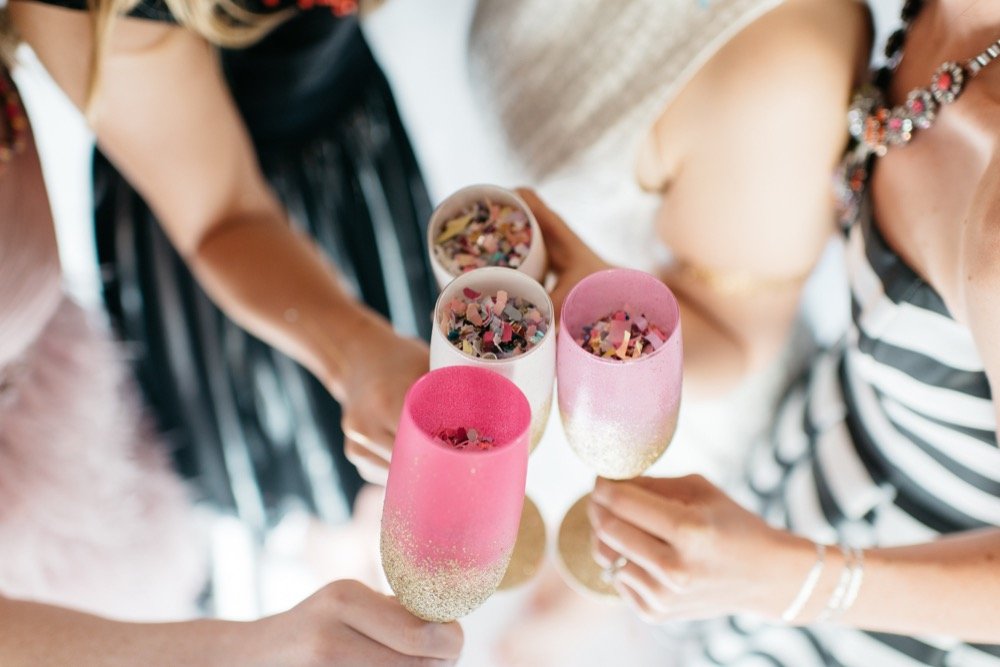
Pour yourself a toast. Tea, champagne, a juice box…whatever calls to you. Raise it to what was, to what is, and to what will be. You don't need anyone else there. Just you, honoring the moment out loud. Clink. Cheers.
Throw an actual pity party. I’m talkin’ the whole thing…balloons, a playlist, snacks, and a bittersweet cake with something written across it in frosting. (It's okay to be sad. Goodbye. It will be okay.) Whatever you need it to say. Giving the sadness a party isn't silly. It's giving it your full attention, on purpose, so you can sit with it and then move through it.
Write it down, then rip it up. Take the thoughts you're carrying, the things you need closure on, and put them on small pieces of paper. Then tear them up and add them to a confetti mix. (Alexis swears tearing the paper is the most cathartic part, and she's probably right.) It works for anger, too, by the way. Confetti has a soft landing, which is sometimes exactly what we need when we want to throw something.
Carry confetti in your pocket. A few little pieces, tucked away. Alexis did this for a whole week once, and she said that every time her hand brushed against it, it brought an unexpected smile. That's the magic of it. A small, silly, hopeful thing you forgot was there, reminding you that joy is still in reach, even on the days you can't quite get to it.
Send some good juju out. When I'm in a real funk, the thing that pulls me out almost every time is doing something kind for someone else. A check-in text. A surprise in the mail. A little confetti handed to a cashier who just dealt with a difficult customer. You can celebrate someone else's joy even when you're down bad, and somehow it loops back around and lifts you, too.
Make a confetti jar of sadness. This one's my favorite. Fill a jar with confetti, and when something makes you sad, write it down and add it in. It's a little like the therapy concept of putting your feelings in a container and setting them aside…except this container sparkles! The feelings are acknowledged, they're real, they're named. And then they're held in their own little space so you don't have to carry them everywhere you go.
How our community celebrates the sad stuff
When I shared this idea with our confetti community (join here!), the stories that came back undid me a little (in the best way). Because it turns out so many of you are already doing this, turning grief into something you can honor, hold, and celebrate.
One friend, JM, told me her mom battled cancer for twelve years. When her mom retired, she gave her a confetti cannon, and her mom said she was saving it for the day she was cancer-free. At the graveside service, JM shot it off and announced to everyone that she was cancer-free now. "We celebrated and grieved and shot a confetti cannon with tears." (For real, I have not stopped thinking about that sentence since I read it. So heartbreakingly beautiful.)
Another mom, AV, lost her son to an overdose. For the entire first year, her family baked a confetti cake every single Tuesday, because even though they were heartbroken, they knew Joe wasn't, and he always loved to celebrate. Some weeks were unbearably hard, and they made room for the honesty of that, too. She told me that choosing to celebrate felt like an act of rebellion. That teaching her kids to make space for grief and joy, for tears and confetti, was essential. She and her husband even have a ritual they call "toasting to their troubles." When the pain is too big to make sense of, they pour a glass and raise it anyway.
And then there are the gentler rituals, the quiet ones. CK wears a necklace with her grandpa's birth year and fingerprint, and on his birthday she works through a written list of all the things she loved about him (petting dogs, smiling at babies, putting cayenne on everything), living like he lived for a day. HP and her family are taking the keepsake fur from their beloved cat Cleo and tucking it inside a Build-a-Bear, so the kids have something to snuggle when the missing hits. DM plants the flowers her late mom and dad loved in her garden, and keeps her dad's stone bench out there, so that every time she steps outside it becomes a happy memorial.
These are all different rituals, but they have same truth running underneath: grief and celebration were never opposites. They've been holding hands this whole time.
People also ask

Is it okay to celebrate when you're grieving? Yes, of course, and it doesn't mean you're "over it" or pretending you're fine. Celebrating while grieving is a way of honoring what (or who) you lost. You can hold sadness and joy in the very same moment; in fact, most of us already do (we just like to beat ourselves up for it. Let’s stop that, mmk? *links pinkies in a promise*)
What is a grief ritual? A grief ritual is any intentional act that helps you acknowledge a loss and the feelings that come with it. It can be as big as a graveside confetti cannon or as small as lighting a candle, planting a flower, or writing down a memory. The point is to give the grief somewhere to go.
How do you honor someone who has passed away? Honor them by celebrating who they were, not just mourning that they're gone. Live out the things they loved, keep a meaningful object close, or mark their important dates with a small ritual. Joy and remembrance can absolutely coexist.
What does it mean to hold joy and sadness at the same time? It means accepting that you can feel two opposite things at once — that a moment can be both bitter and sweet — without either feeling canceling out the other. It's one of the most human things we do, and learning to allow it is its own kind of healing.
The permission slip
We live in a world that's decided celebration belongs only to the happy things. And I think that's the very thing worth turning upside down.
Every emotion you feel deserves as much attention as joy does. The sadness, the anger, the anxiety, the bittersweet ache of a chapter ending…all of it is part of what makes you human, and none of it should be something you feel ashamed to feel. So this is your permission slip. To not put on the happy face. To disconnect from "business as usual" for a minute and just be in it. To throw the confetti through the tears.
Celebrating the sad stuff is never about pretending it doesn't hurt. It's about loving yourself enough to say the hard moments are worth marking, too. Make room for the grief and the joy. The tears and the confetti.
And if you want something to help you build these little rituals — confetti to scatter on the floor beside you, to carry in your pocket, to fill a jar that holds the heavy things gently — the shop is here whenever you're ready.
Now go ahead. Have the good cry. Eat the pity party cake. And throw a little confetti to celebrate all the sad and beautiful things that make you human.